
 Furniture
Clad Stainless vs. Nonstick Cookware: What to Buy First
Clad stainless sears and builds pan sauces; nonstick makes eggs easy but wears out. How each works, how to care for it, and a sensible first set of pans.
Quick answer
- If you’re buying one good pan first, make it a 10- to 12-inch clad stainless skillet for searing, browning and pan sauces.
- Add one nonstick fry pan for eggs, pancakes and delicate fish, and keep it on low to medium heat.
- Replace nonstick once the coating is damaged; clad stainless has no coating to wear out.
- Round out the kit with a 3-quart saucepan and a Dutch oven before adding anything else.
What “clad” means: 3-ply and 5-ply
Clad cookware is made by permanently bonding layers of different metals under heat and pressure so they act as one material. In a typical clad stainless pan, stainless steel forms the cooking surface and the outside of the pan, with a core of aluminum (in some lines, copper) in between.
The reason is heat. As one clad cookware maker explains, stainless steel is durable and nonreactive but conducts heat poorly, while aluminum spreads heat well but reacts with acidic ingredients. Bonding the two gives a pan that heats evenly and still has a stainless cooking surface, so tomato sauce or a wine reduction won’t react with the metal.
- 3-ply (tri-ply): stainless, aluminum, stainless. The same maker describes its 3-ply line as responsive, with fast, even heat.
- 5-ply: more layers between the stainless surfaces. That maker describes its 5-ply line as giving steadier, more controlled heating and better resistance to warping.
Also check whether a pan is fully clad, with the layers running up the sides, or has a bonded disc only on the base. Fully clad pans spread heat up the sides as well as across the bottom; disc-bottom pans keep the heat-spreading layer in the base.
How clad stainless and nonstick cook differently
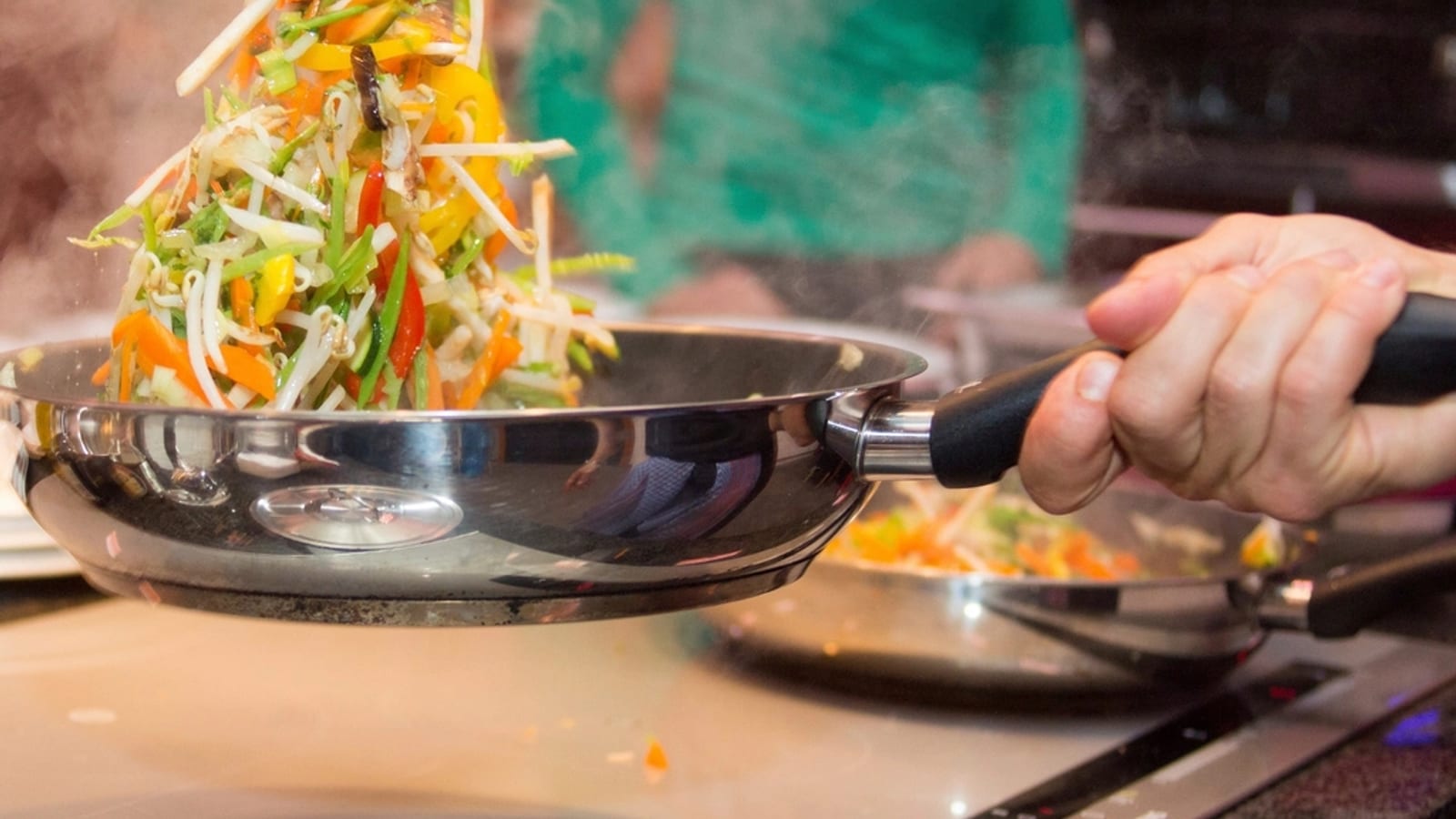
Clad stainless is the pan for browning. Seared meat, browned vegetables and the browned bits (fond) left behind are what make a quick pan sauce: add stock or wine, scrape, reduce. The tradeoff is sticking. One stainless maker’s method is to preheat the pan over low to moderate heat until a few drops of water dance on the surface, add enough oil to coat the pan, and add the food once the oil is hot. Then give the food time to brown before you try to move it.
Nonstick is the pan for food that tears or glues itself down: eggs, pancakes, crepes and delicate fish. It needs little fat and cleans up fast. The tradeoffs are heat and durability. Makers ask you to cook on low or medium heat, and the coating wears with use.
That’s why owning one of each makes sense. A stainless skillet for searing and sauces plus a nonstick pan for breakfast covers most stovetop cooking.
Nonstick types: PTFE and ceramic
PTFE (polytetrafluoroethylene) is the classic slick nonstick coating, and it belongs to the group of chemicals known as PFAS. Since the 1960s, the FDA has authorized specific PFAS-containing substances for food-contact uses, including nonstick cookware coatings. To get that authorization, manufacturers must show a reasonable certainty of no harm from the intended use. The FDA explains that the coating is applied at very high temperatures that bind it tightly to the pan, and it says studies show only negligible amounts of PFAS in the coating can migrate to food.
Ceramic nonstick is a different coating: a silica-based layer applied by a sol-gel process, often over an aluminum pan, and typically made without PTFE or other PFAS. Makers of both types give similar heat advice: cook at low or medium heat.
Whichever coating you choose, the same habits help it last:
- Cook on low to medium heat, never leave an empty pan on high heat, and stay within the maker’s heat limits.
- Use plastic, nylon, silicone or wooden utensils unless the maker says metal is fine, since metal can scratch the coating.
- Skip nonstick cooking sprays. One maker warns they may reduce the coating’s performance over time; a little oil or butter works instead.
- Hand wash with a soft sponge.
- Replace the pan once the coating is damaged, as at least one major nonstick maker recommends; scratches can reduce how well it releases food.
If you keep pet birds, ask your veterinarian about cooking with PTFE pans, because fumes from overheated PTFE can harm birds.
Oven and induction: check the fine print
Oven limits depend on the pan body, the coating, the handles and the lid. One clad cookware maker rates its stainless pans for the oven and broiler up to 600°F, its nonstick pans to 500°F (450°F for its ceramic nonstick line) and its glass lids to 350°F. An enameled cast iron maker lists 500°F for its enameled pieces. Treat these as examples and check the rating for the exact piece you buy, including the lid and any knobs.
For induction cooktops, the ENERGY STAR program offers a simple test: hold a magnet to the bottom of the pan, and if it sticks, the pan will work with induction. It lists cast iron, stainless steel and enameled cast iron as materials that work, and notes that many compatible pans show an induction logo on the box. Test nonstick pans too. A pan with an aluminum body needs a magnetic base before it will heat on induction.
Enameled cast iron, and all three side by side
Enameled cast iron is cast iron coated in a glassy enamel. It’s heavy and holds heat, which suits braises, soups, stews and bread baked in a covered pot. Care is simple but specific. One maker’s guidance: use low to medium heat, don’t heat an empty pot on the stovetop, don’t add cold ingredients to a hot, empty pan, and use wooden, silicone or nylon utensils because metal can scratch the enamel. The same maker says its enameled pieces can technically go in the dishwasher but prefers hand washing to protect the finish.
| Feature | Clad stainless | Nonstick | Enameled cast iron |
|---|---|---|---|
| Use it for | Searing, browning, pan sauces | Eggs, pancakes, delicate fish | Braises, soups, stews, bread |
| Stovetop heat | Preheat on low to moderate | Low to medium only | Low to medium |
| Watch out for | Salt added to cold water can pit the surface | Overheating, metal tools, sprays | Heating empty, cold shocks, metal tools |
| Cleanup | Nylon pads, no steel wool | Hand wash, soft sponge | Hand wash preferred |
| Induction | Often; try a magnet | Only with a magnetic base | Yes; try a magnet |
About that salt warning: to prevent pitting, one stainless maker advises adding salt only after the liquid boils or the food has started cooking.
What to buy first: a set or piece by piece
A set gets you matching pieces in one box, which is handy for a new kitchen. Before choosing one, count the actual pots and pans rather than the number on the box, since lids often count as pieces, and make sure the sizes fit how you cook. Browse cookware sets with that list in hand.
Building piece by piece lets you pick the right material for each job. A practical order:
- A 10- to 12-inch clad stainless skillet for searing, sautéing and pan sauces. Start with fry pans and skillets.
- A 3-quart saucepan for rice, grains, sauces and reheating. See saucepans and sauciers.
- An 8- to 10-inch nonstick fry pan for eggs and other delicate food.
- A Dutch oven in enameled cast iron or clad stainless for soups, braises, chili and bread. See Dutch ovens and braisers.
- A stockpot once you’re cooking pasta, stock or big batches regularly. See stockpots.
With those five pieces you can sear, simmer, fry, braise and boil, and real cooking will show you which piece to add next.
Frequently asked questions
Is 5-ply cookware better than 3-ply?
Why does food stick to my stainless pan?
Can nonstick pans go in the dishwasher?
When should I replace a nonstick pan?
Will my pans work on an induction cooktop?
 Kitchen & CoffeeTilt-Head vs. Bowl-Lift Stand Mixers: How to ChooseHow tilt-head and bowl-lift stand mixers differ, which bowl size fits your baking, how to knead dough without straining the motor, and…
 Kitchen & CoffeeBetter Drip Coffee at Home: Brewer, Grinder and RatioWhere to start on the coffee-to-water ratio, what brewing temperature to look for in a drip machine, why the grinder matters, and…
 Kitchen & CoffeeSemi-Automatic, Super-Automatic or Pod Espresso Machine?What semi-automatic, super-automatic and pod espresso machines each do for you, how much practice and cleaning they take, and how to pick…