
 Furniture
Towing and Hauling Tires: A Checklist for Trucks and SUVs
Towing puts extra weight on your rear tires. Here is how to read the door labels, check axle and tongue weights, set pressures and choose tires that carry the load.
Quick answer
- Read both door-jamb labels: the tire placard gives sizes and cold pressures, and the certification label gives GVWR and the front and rear axle ratings (GAWR).
- Tongue weight counts as cargo. Truck makers’ towing guides generally call for 10% to 15% of a conventional trailer’s loaded weight on the hitch, and that weight uses up payload and loads the rear axle.
- Check tire pressure cold before every tow, using the placard or owner’s manual figure. Underinflated tires run hot and can fail.
- Replacement tires should carry at least what the originals did at placard pressure; heavy-duty pickups commonly use LT load range E.
A trailer or a loaded bed adds weight to your tires, and most of it lands on the rear axle. The numbers you need are printed on the truck or SUV itself. Here is how to read them, set your pressures and choose tires that can carry the load.
Start with the labels on the driver’s door
Two labels do most of the work. The Tire and Loading Information placard lists the original tire sizes, the recommended cold pressures for the front, rear and spare, and a line stating that the combined weight of occupants and cargo should never exceed a set number of pounds. The certification label on the door edge or latch pillar lists the gross vehicle weight rating (GVWR) and the gross axle weight rating (GAWR) for each axle.
GVWR is the most the fully loaded vehicle may weigh. GAWR is the most each axle may carry, measured where the tires meet the ground. Federal standards require vehicle makers to fit tires whose combined maximum load ratings on each axle are at least that axle’s GAWR, with passenger-type tires on trucks and SUVs counted at their rating divided by 1.10. Payload, the weight of people and cargo the vehicle can carry, is the GVWR minus the curb weight.
| Where to look | What it tells you |
|---|---|
| Tire and Loading Information placard (driver’s door) | Original tire sizes, cold pressures front, rear and spare, and the occupant-plus-cargo limit |
| Certification label (door edge or latch pillar) | GVWR and front and rear GAWR, often with tire size, rim size and pressure data |
| Label on the hitch receiver | Trailer weight and tongue load limits for weight-carrying and weight-distributing use |
| Owner’s manual | Towing limits, required equipment and any special tire or pressure guidance |
Tongue weight lands on your rear tires
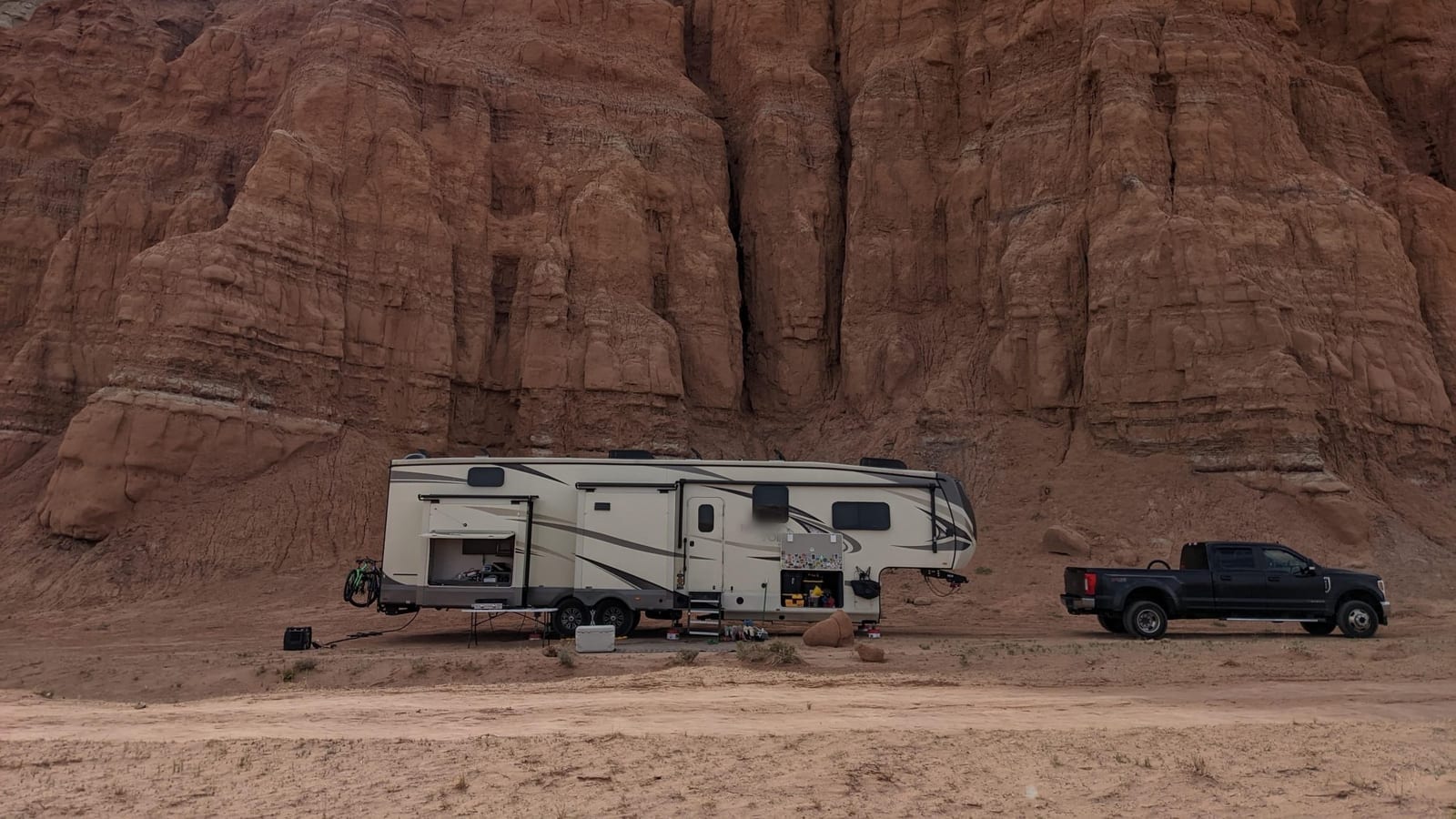
Tongue weight is the part of the trailer’s weight that presses down on the hitch. It counts as cargo, so it uses up payload and adds load to the rear axle. Truck makers’ towing guides generally put it at 10% to 15% of the loaded trailer weight for a conventional trailer and 15% to 25% for a fifth-wheel or gooseneck. Some trailers, boat trailers in particular, fall outside those ranges, so check the trailer maker’s figure as well.
The numbers add up quickly. At 10% to 15%, a 7,000 lb travel trailer puts 700 to 1,050 lb on the hitch. Add passengers, gear in the bed and the hitch itself, and you can reach the rear GAWR or the GVWR before the trailer gets near the truck’s maximum towing figure. One truck maker’s guide, for example, calculates its maximum trailer weights for a truck with no cargo and only a 150 lb driver and passenger.
Tongue weight affects control as well as tire load. One maker’s towing guide warns that too much can press the rear down and lift weight off the front wheels, cutting traction, steering response and braking, while too little can reduce rear-wheel traction and cause sway. The only sure check is a scale: weigh the truck and trailer loaded for the trip, then compare each axle with its GAWR and the truck’s total with its GVWR. A weight-distributing hitch spreads some of the tongue load to the front axle and the trailer axles.
Set pressures cold, before every tow
Check tire pressure at least once a month and before a long trip, a heavy load or a tow, with the tires cold, meaning parked for at least three hours. Use a gauge; the dashboard warning light is not a replacement for regular checks. Set the pressure from the placard or owner’s manual, not the maximum molded on the sidewall.
Keep any front-to-rear difference the placard shows, and if your owner’s manual lists a separate pressure for heavy loads or towing, use it. Recommended pressures are cold readings that leave out the build-up from driving, so set them before you leave rather than letting air out of hot tires at a rest stop.
Getting this wrong cuts both ways. One truck maker’s towing guide warns that underinflated tires get hot and may fail, which can lead to loss of control, while overinflated tires may wear unevenly and compromise traction and stopping. The same guide suggests stopping somewhere safe after about 50 miles to recheck the hitch, the lights and the trailer’s lug nuts.
Heat, speed and long grades
A tire that is underinflated for its load runs hotter, and heat shortens its life. One tire maker’s thermal images show an LT tire at 30 psi running considerably hotter than the same tire at 50 psi under the same load. Speed adds heat too: running past a tire’s speed rating can overheat it, and the rating assumes correct inflation and load in the first place.
On long downgrades, shift to a lower gear so the engine helps the brakes. Stay within the speed rating of the tires on both the truck and the trailer, and remember that a speed rating comes from a lab test, not a safe towing speed. Check whether your owner’s manual sets its own speed limit for towing.
Carry a usable spare. One truck maker’s guide calls for a conventional full-size spare identical to the road tires when towing, and says mini, compact or mismatched spares should not be used. Check the spare’s pressure along with the others.
Choosing replacement tires for a tow vehicle
Tire makers’ guidance is that any replacement on a light truck should carry at least as much load as the original equipment tire. That means matching the placard’s size and load index or load range, or having a tire shop confirm the numbers in the load tables if you change sizes or tire types.
Heavy-duty 3/4-ton and 1-ton pickups commonly come from the factory on LT tires in load range E; replace them with at least the same load range. Many half-ton pickups and SUVs come on P-metric or Euro-metric tires instead. Switching those to LT tires does not raise any vehicle rating, and LT tires need more air to carry the same load: in one tire maker’s half-ton example, the LT replacement needed 45 psi where the original P-metric tire ran at 35 psi. Expect a firmer ride at those pressures.
Keep the same size, type and load range on all four tires unless the placard lists different front and rear sizes. One major tire maker recommends replacing all four at once with identical tires, and warns that on four-wheel-drive and all-wheel-drive vehicles a difference in rolling circumference between axles can damage the drivetrain. Check the owner’s manual before mixing anything.
Tread pattern comes down to where you tow. Highway and touring tires are designed mainly for paved roads. All-terrain tires are also built for gravel, dirt and unpaved ramps, so they make sense if your towing regularly leaves the pavement. Whichever you choose, confirm that the size you need comes in the load range your placard calls for. To browse by vehicle instead, start with light truck tires or SUV and crossover tires.
Frequently asked questions
Do I need LT tires to tow with a half-ton pickup?
Should I run the maximum sidewall pressure when towing?
Does tongue weight count against my truck's payload?
How do I find my actual axle weights?
 Tire GuidesWhen to Put On Winter Tires (and What the Snowflake Means)The 45°F rule of thumb, what the three-peak mountain snowflake and M+S marks mean, why winter tires go on all four wheels,…
 Tire GuidesWhy Tire Pressure Drops in Cold Weather (and What to Do)How much tire pressure drops as temperatures fall, why the TPMS light comes on during cold mornings, and how to check and…
 Tire GuidesWhen to Replace Tires: Tread Depth, Age and Warning SignsTread depth, age and damage all decide when a tire is done. How to run the penny and quarter tests, read uneven…